
Atomic Habits: Small Changes That Create Big Results
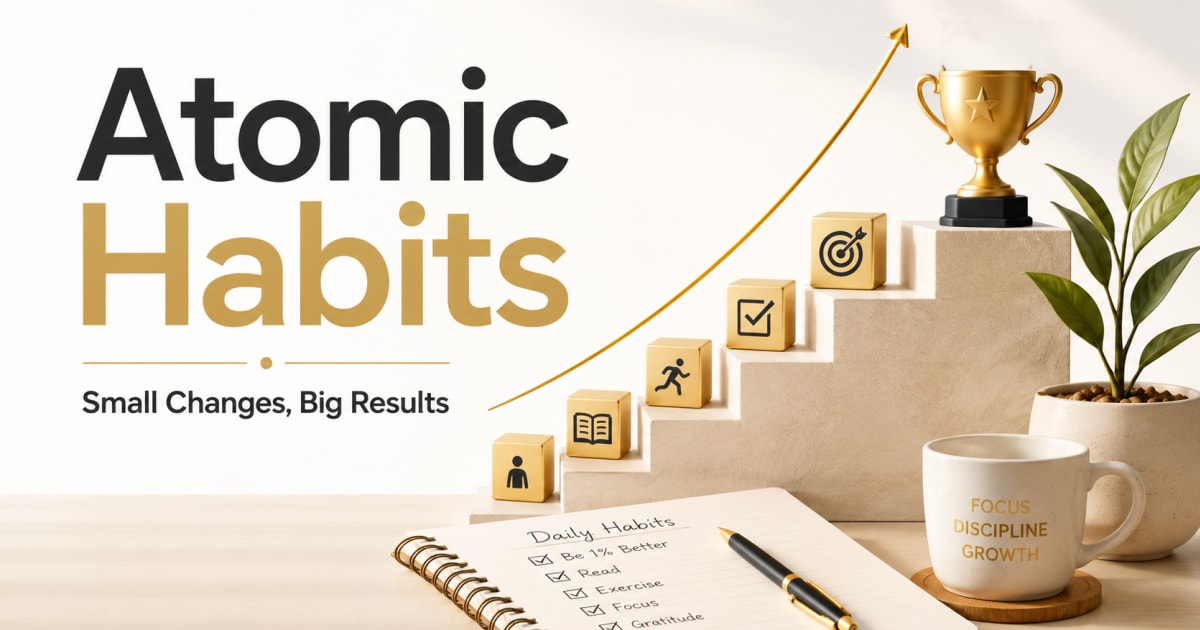
Atomic Habits teaches us that success does not come from one big action, but from small daily improvements. This blog explains how tiny habits, identity-based change, and simple systems can transform your life, productivity, and mindset over time.
Atomic Habits: Small Changes That Create Big Results
Most people think success comes from big decisions, big motivation, or one powerful moment. But in reality, real success is built quietly through small daily habits.
This is the core idea of Atomic Habits by James Clear.
The book explains that if you improve just a little every day, those small improvements become powerful over time. A habit may look small in the beginning, but when repeated consistently, it can completely change your life.
What Are Atomic Habits?
An atomic habit is a small habit that is easy to do but powerful when repeated regularly.
For example
Reading two pages daily may look small.
Walking for ten minutes may look simple.
Saving a small amount of money may not feel big.
But when these habits continue for months and years, they create major results.
Small habits are like seeds. At first, you do not see much change. But with time, they grow into something strong.
Why Small Habits Matter
Many people fail because they focus only on goals.
They say
“I want to become successful.”
“I want to lose weight.”
“I want to become productive.”
“I want to read more books.”
Goals are important, but goals alone are not enough.
Atomic Habits teaches that we should focus more on systems.
A goal is the result you want.
A system is the daily process that takes you there.
For example, if your goal is to become fit, your system is daily exercise, healthy food, proper sleep, and consistency.
If your goal is to become knowledgeable, your system is daily reading, learning, and practice.
Success does not come from setting goals only. Success comes from building the right system.
The Power of 1% Improvement
One of the most powerful ideas in Atomic Habits is the concept of getting 1% better every day.
At first, 1% improvement feels very small. You may not notice any major difference in one day or one week.
But slowly, your small efforts compound.
Just like money grows with compound interest, habits also grow with consistency.
A small good habit repeated daily becomes a strong advantage.
A small bad habit repeated daily becomes a serious problem.
That is why our daily routine matters more than we think.
Identity-Based Habits
Atomic Habits also teaches that real change starts with identity.
Most people say
“I want to read books.”
“I want to exercise.”
“I want to become disciplined.”
But a better mindset is
“I am a reader.”
“I am a healthy person.”
“I am a disciplined person.”
When you change how you see yourself, your actions start matching that identity.
If you believe you are a disciplined person, you will naturally try to act with discipline.
Your habits are proof of your identity. Every small action is like a vote for the person you want to become.
The Four Laws of Behavior Change
James Clear explains habit-building through four simple laws.
1. Make It Obvious
Your habit should be easy to notice.
For example, if you want to read daily, keep a book on your table.
If you want to drink more water, keep a water bottle near you.
Your environment should remind you of the habit.
2. Make It Attractive
The habit should feel interesting or rewarding.
For example, you can listen to your favorite music while walking.
You can study in a clean and peaceful place.
When a habit feels attractive, you are more likely to repeat it.
3. Make It Easy
Do not make the habit too difficult in the beginning.
If you want to exercise, start with five minutes.
If you want to write, start with one paragraph.
If you want to read, start with one page.
The easier the habit is, the easier it becomes to start.
4. Make It Satisfying
You should feel some reward after completing the habit.
This reward can be simple: marking a calendar, tracking progress, or feeling proud of yourself.
When your brain feels satisfied, it wants to repeat the habit again.
How to Break Bad Habits
Atomic Habits does not only teach how to build good habits. It also teaches how to break bad habits.
To break a bad habit, reverse the four laws.
Make it invisible.
Make it unattractive.
Make it difficult.
Make it unsatisfying.
For example, if you waste too much time on your phone, keep it away while working. Turn off notifications. Remove distracting apps from the home screen.
The goal is not to depend only on willpower. The goal is to design your environment in a smarter way.
Environment Is More Powerful Than Motivation
Motivation comes and goes. Some days you feel inspired, and some days you do not.
That is why relying only on motivation is risky.
Your environment plays a big role in your habits.
If your room is full of distractions, focus becomes difficult.
If your study table is clean, learning becomes easier.
If healthy food is available, eating healthy becomes easier.
A good environment makes good habits easy and bad habits difficult.
Consistency Beats Intensity
Many people start with full energy but stop after a few days.
They try to do too much too quickly.
Atomic Habits teaches that consistency is more important than intensity.
Doing something small every day is better than doing something big once in a while.
You do not need to be perfect. You just need to keep going.
Even if you miss one day, do not miss twice. One mistake is normal, but repeating it can become a new bad pattern.
Final Thoughts
Atomic Habits is not just a book about habits. It is a practical guide for self-improvement.
It teaches us that big success is not created overnight. It is created through small actions repeated daily.
Your future is shaped by your daily habits.
If you want better results, do not only focus on big goals. Focus on your small daily actions.
Because in the end, you do not rise to the level of your goals. You fall to the level of your systems.
Start small. Stay consistent. Improve daily.
- That is how small habits create big results.
Tags
UniqueIIT Research Center
TechUniqueIIT Research Center publishes research-driven learning resources and evidence-based content.